Adam Pospíšil, Prague, September 9, 2007
Discovering Japan through school and family life
A report about my participation in the Japan-Europe Mutual Understanding Scholarship Program
When I found out in the spring that I would take part in the Japan-Europe Mutual Understanding Scholarship Program, I was both looking forward to having such a great opportunity, as well as a little bit worried about my ability to deal with it, as it was the first time abroad for more than a month. However, my worries turned out to be rather irrelevant, firstly when I got an e-mail from my host family, which assured me that I was going to meet wonderful people in Japan, and secondly during my travel to Tokyo when, beginning with my transfer in Amsterdam, Japanese proved to be outstanding coordinators, who managed to make the participants always feel safely and were prepared to solve any difficulty at any time. This fact laid an important basis for successful conduct of the whole program.
When all of the thirty students from different European countries came to Tokyo, we spent one week together at a hotel to get prepared for the main part of the program – the homestay in Japanese families. Even meeting all the Europeans on its own was a very enriching experience, as there were many exceptional persons with strong interest in Japan from whom I could learn much. For me it was a great feeling to try to speak Japanese in a real situation because I had only learned it at school so far.
As to the language training, a program of this kind proved to be the best way of advancing one's skills, as it enabled me to apply the grammatical knowledge, which I had attained at school, to real conversation, and although I almost had not been able to use day-to-day Japanese before, I started to catch frequent phrases and words much easier when experiencing the environment twenty four hours a day (Of course, if I want to achieve a satisfactory level of the spoken or even written language, there is a great deal of study yet.).
We were given several lectures on life in Japan, including one by Mr. Yokoyama who is an amazing man familiar with many cultures and languages of the world and thus able to provide us with a lot of useful information and advice about communication with Japanese and common mistakes occurring in contact between Japan and other cultures. Generally, I appreciated that all of the International Friendship Association members who were in charge of us were experienced in dealing with foreigners and were fully prepared to present Japan to us, Europeans for almost all of whom it was their first visit to the country of raising sun. We also spent two days attending a language school. We mostly learnt how to deal with ordinary situations like offering a meal or visiting a Japanese household. The third day we tried to use our Japanese finding out information about the history of the ancient metropolis in the Edo-Tokyo museum. We also took a sightseeing tour on a boat and tried to attend correctly a Shinto shrine our first time and saw shrines and Buddhist temples in Asakusa, being told some facts about religion in Japan. This was very appreciable, as the attitude towards religion is different from Europe in many ways. One of the most interesting aspects of it is what my host family's grandfather explained to me later, saying that he is a fifty-percent Shintoist and fifty-percent Buddhist.
After a week we had to separate and set off for our host families´ homes, curious about people with whom we were to spend more than three weeks. My travel was probably the most comfortable one, as my host family lives in Tokyo and both parents and my host sister Miyuki came for me to the hotel.
From the first moments during our ride home which was also a sightseeing of new places in Tokyo, I knew that I would spend the whole time with wonderful people who would help me in discovering of Japanese life.
My new home was a three-store house in a very calm area. It is not far from the temples and shrines in Asakusa which we visited several times to enjoy omatsuri, a festival when people attend shrines and temples and the area is full of shops selling various traditional goods and all kinds of food.
My host sister Miyuki has two younger brothers who were very nice to me all the time and for example politely tried to speak the clearest Japanese they could to make me understand. A very interesting aspect of my family is that my host mother is Finnish, thus I could see how a European could find her home in Japan more than twenty years ago.
Having the possibility to see the Japanese family life was something I could not have experienced as a tourist. My host mother is a housewife which is as busy an occupation as any other job, as she not only takes care for the household and prepares children to school, giving them always a nice home-made lunch, not to mention all the delicious meals she cooks each day, but, for example, she also takes part in organizing different training trips of the soccer club the boys go to. She also often helps the schools her children attend or attended even in the past. These activities of parents getting involved in school and club matters are much better developed in Japan than in the Czech Republic.
Discovering the school life was the second most important point. I attended Kanto International Senior High School which is a large prestigious school with special language education. That means that students can choose from more languages than usual. Also many native speakers allow for precise language learning. When I first came to school, students from my class surprised me very much when they welcomed me with a song and made a little party in the afternoon, which proved again the Japanese hospitality. As to the classes, the school is probably more strict than usual Czech schools, as students wear uniforms and each class starts with a formal greeting, but on the other hand it seemed to me not to be exaggerated and I think that students can feel very well in the school environment, themselves being rather quiet during the lessons, which allows the teacher not to get angry with them all the time. At my school there were many so called bukatsu or school clubs which took place in the afternoon, in the weekend or during vacation. Students can choose from many activities. So while Miyuki went to the dancing club, I attended the school brass band. I was very pleased to hear that top bands of that kind are common in Japanese schools.
I also had time to visit many interesting places in Tokyo. My impression from the city was not that of a too busy place where all streets and underground are always full of rushing crowds. One can calmly walk through the city and the transport is incredibly comfortable. I was quite surprised when we visited some places located in the middle of the modern city, where one could find complete silence and attend a shrine or a temple. Among other places, I went for example to the absolutely amazing second-hand books area in Kanda where you can find all kinds of books in many languages all in one place. Another place where a particular article is sold in many shops next to each other is Akihabara where one can find hundreds of shops with electronics.
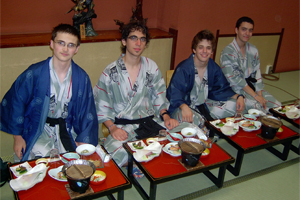
During weekends and a vacation students had after writing final tests my family also took me to several places outside Tokyo. Once my Japanese grandfather and grandmother invited us to a Japanese-style hotel for one night where I ate the traditional Japanese dinner sitting on the floor and went to the onsen, a Japanese bath. The grandfather and grandmother are unbelievably great people who explained to me many things about Japan and with whom I also talked about differences between Japan and Czech Republic. We also visited together a museum of automatic musical instruments where, by the way, a Czech string quartet played each day which proved the Japanese affection for European and particularly Czech music.
I mentioned a few major points of my homestay, but I consider the same important every moment when I talked to my host mother, my host sister or some of my classmates, often during our travel to school by the underground, when I had the opportunity to discover Japan through communicating with people in ordinary situations.
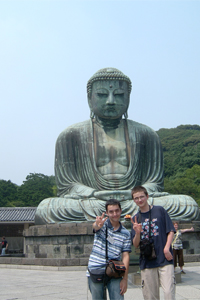
When all of the thirty Europeans came again to the hotel in Tokyo, we shared our feelings about homestay and together visited Kamakura where we saw the Kamakura daibutsu – Buddha of Kamakura, a great statue, which is one of the most famous spots for tourists as well as Japanese school trips, with whom we took many photos in front of the sitting Buddha. At last, we talked with the coordinators about our impressions and things we liked or disliked during the homestay.
What I brought home with me from Japan is not only a good feeling of improving my Japanese, but most of all an experience of Japanese life seen not from a sightseeing bus but from inside a Japanese family and school. Thus I hope that I could at least a little bit discover the richness of the country of the raising sun.